I'm going to let you know up front that I'm not terribly political... I believe in having my voice heard and I write my representatives on various levels on my opinion over many different issues that are important to me. I think that's an important part of being an American in a democracy--that our voices are heard. That's why I vote and that's why I tell my reps what I think is important. But I really hate polarization in politics. It's really not too important to me whether someone is a Republican, Democrat, Libertarian or whatever; I just want them to act responsibly, tell the truth (as much as possible!) and listen to constituents. I do have my own leanings, which I'm sure you could guess at, but that's neither here nor there nor what I really want to write about today.
I wanted to write about how excited I felt last election. I remember driving home and listening to debates on the radio between the candidates and I couldn't believe that in my lifetime, a woman and a black man were serious candidates for a ticket. That meant a lot to me. I'm a mom, and my children are bi-racial. I made sure to talk to them about what was going on. When Hillary Clinton was a serious candidate for the Democratic ticket, I was thrilled. When I found out about Obama, I was also thrilled: he was just like my children who are half black, half white. I thought, what a great time for them to be alive and see that America is truly a place where anyone can succeed--no matter their race or gender. I've always wanted to see a woman as a President, too--and I hope I live to see that also.
One thing I've noticed during Obama's presidency is how proud my daughter is of him. She really does feel he is "just like her." Her remarks are often something like "he has skin like me" or "his parents were like mine." Pretty cool for a little girl to identify with the President. One of my daughter's favorite books is Grace for President by Kelly DiPuchhio and illustrated by LeUyen Pham. In the book, Grace discovers to her dismay that there has never been a woman US President and she runs for class president. It really captures the kind of excitement an election can bring.
I'm sorry the excitement is gone from this election. I miss it terribly. Last election, it felt like history was being made and this year it feels like "business as usual."
I know it's been about forever that I've posted on my blog. I'm going to work on that. Really I am.
In the spirit of Christmas, I want to share a "cause" with you! It's Books for Teens which is sponsored by the Young Adult Library Services Association (YALSA). The mission is to provide high quality books to teens that really need them. Books can change a young person's life. They can help someone in a bad situation see that they are not alone and that there are solutions to problems that they face every day. Check out the site and give! It's the season!
This parody manga is very funny and you really can't take it at face-value. On the surface, DMC seems nasty and mean-spirited, but it's really a send-up of death-metal music, cruel and opportunistic people and the idea of coolness.
The first manga doesn't really tell much of a story--it's episodic with glimpses into Soichi's life. We know that sweet, mama's boy Soichi moved to Tokyo to play nice Swedish Pop Music. We also know that didn't happen--instead he somehow ended up in the death metal band, Detroit Metal City (DMC). Soichi, as the lead singer, Krauser II, is worshiped by death-metal fans everywhere, even while he's very uncomfortable with his status as an underground music phenomena. It's good that his alter ego, Krauser II, wears makeup and a wig on stage, otherwise Soichi's mother might learn what he's up to. Krauser supposedly killed his parents and has raped his way across Japan. He's not the image Soichi wants to project, especially to his nice love-interest who thinks Krauser is a jerk and DMC is a terrible band.
I have to say that I've never read a manga that used the word "rape," "sows" or "f*ck" as much as DMC does. It's good to remember that this is a parody! In one DMC song, Soichi as Krauser out-sings a rival death-metal singer by screaming the word "f*ck" more times without taking a breath. The humor is often crude, but that's part of what's being made fun of. Nothing is taken seriously and I laughed quite a bit.
I enjoyed the art, too. It's not beautiful art, but it has a sort of a sweet vulnerability--a nice contrast for the subject matter and not unlike Soichi himself.
There is an anime and a live-action movie version. I think this manga is worth checking out, but it's not for everyone!
Check out the official website for more insanity. This video mashup from the live action movie also captures much of the spirit of the manga:
This is the sequel to Rampant so it may will contain spoilers! In Rampant we meet Astrid Llewelyn and her unicorn-obsessed mother, Lilith. Astrid once thought that unicorns were imaginary and that her mother was just a little crazy. However, a chance encounter with a small unicorn known as a zhi takes Astrid into a world she wished never existed.
In Peterfreund's world, unicorns are savage, poisonous beasts and virgin women like Astrid are unicorn hunters. They are actually the only humans who can sense and kill the powerful and intelligent creatures.
In the first book, Astrid learns about the hunters' connection and ability to sense and connect with the unicorns. Whenever they are around unicorns their senses and skills improve. The unicorns and the hunters share an uneasy, strange bond. In the first book, Astrid uses this bond to her advantage to destroy an entire mega-herd of angry kirin unicorns.
In Ascendant, when Astrid encounters and helps a member of the Gordian drug company manage a captive herd of einhorn unicorns, she finds that not only is she able to sense unicorns, but she's also able to feel "transcendent." Astrid describes the feeling of being surrounded by creatures she normally would be hunting like this: "I caught my breath and reveled in their nearness, suddenly hungry for the feel of them, the scent, the strange comfort their nearness brought me. I wanted this," (p. 169).
Astrid is working for Isabeau Jaeger, who is now head of Gordian pharmaceuticals. Astrid feels safe for a while under her care. Her work managing Isabeau's captive herd of einhorn allows her to take college classes and make money for the other hunters back in Rome.
A lot of strange things are happening around Europe, however. Every time a hunter is found, she loses her eligibility (read: virginity) almost immediately. Also, Cory is losing her ability to sense unicorns. Working with Isabeau helps Astrid understand more about what the Remedy isn't and keeps her hoping she'll find out what it is.
In Ascendant, we also see Astrid think she's found herself only to see her losing her sense of self over and over again. The things that Astrid wants for her life are tragically just out of reach. Over all of this is the sense that Alexander's powerful and dangerous karkadann, Bucephalus, is still watching her and reaching through her dreams. What he wants from her is alien and uncertain.
I can't wait to read another book in this series. I'm tentatively hopeful it will be out in the next few years. (Fingers crossed!)
We recently weeded Computers: A New True Book by Karen Jacobson. It was published in 1982. ISBN: 0516016172
From page 25 and 27 under the section entitled "Modern Computers":
"Since Hollerith's time punch cards have been greatly improved....Computers can receive 'input' from holes punched in cards or paper tape, from computer keyboards and special magnetic tapes."
Will Grayson, Will Grayson by John Green & David Levithan
Summary
The story is about two teens, both named Will Grayson. Each Will narrates the story in alternating chapters. The first Will is friends with a huge, unrelentingly cheerfully gay, rich football player named Tiny. The other Will falls for Tiny.
The plot of the story is very loose: two kids who otherwise would have never met do meet in Chicago at a very improbable place under unlikely circumstances. Tiny's musical, which he's producing with the school's help and funding, is also something that advances the story since both Wills become entangled in it. The ending of the story is really beautiful, and of course, I'm not going to give it away.
What I Thought
I loved Will Grayson, Will Grayson. The story was delightful from start to finish. However, as much I enjoyed the two Wills, it's Tiny that the story really revolves around. Each Will becomes caught up in his hugeness, his over-the-top wonderousness. As each different Will experiences Tiny, their lives are changed.
This read was really great fun for me. The supporting characters are all fully realized, too, which is a neat touch. Will Grayson number 2's mom, for example, is very interesting. Figuring out what happened in her life would be a story in itself. Jane, Will Grayson the first's, love interest is one of the coolest girls I've read about in any story.
This book was donated to our library today. I love the cover. It looks like he is looking for answers--for what?... I'll let your imagination roam.
Here's the Bib info:
Mears, Henrietta. What the Bible is All About: An easy to understand survey of the Bible. Regal Books Division, 1953. ISBN: 0-8307-0072-2
Favorite passage after flipping through it from page 448:
"God has X-rayed the human heart and has given us the picture. He shows us what He finds in us all. The findings are so terrible that they cannot be read in a mixed audience. But remember, this is the picture of us that God sees."
Retro cover: 4 stars
Depressing interpretation of a holy book: 1 star
Bibliography
Parnell, Peter and Justin Richardson. And Tango Makes Three. Simon & Schuster Children's Publishing, 2005. ISBN: 0-6898-78451
Summary
Roy and Silo are two male chinstrap penguins that paired up together at the Central Park Zoo. For years, they displayed courting behavior, made a nest together and tried to hatch rocks. One day a zoo keeper gave the pair an abandoned egg that they hatched successfully. Tango was the baby they raised together. This is based on a true story.
What I Thought
I thought this book was adorable! My partner and I raise two awesome children and it's really a breath of fresh air to have books out there about families like ours. The illustrations by Henry Cole are cute and animated. My children enjoyed reading the book with me.
This book is, however, one of the most challenged books on the ALA list because it depicts a homosexual relationship (between penguins). I understand that this is a sensitive issue to some people who feel that homosexuality shouldn't be exposed to their children. However, love, partnership, parenting and relationships are beautiful things no matter who you love. This book is beautifully accepting of Roy and Silo and shows how people (like the zoo keeper in the story) can look past the "gay" and see the love.
Outside Reviews
"Tango has two daddies in this heartwarming tale, inspired by actual events in New York's Central Park Zoo. Two male penguins, Roy and Silo, "did everything together. They bowed to each other.… They sang to each other. And swam together. Wherever Roy went, Silo went too. … Their keeper… thought to himself, 'They must be in love.'" Cole's (The Sissy Duckling) endearing watercolors follow the twosome as they frolic affectionately in several vignettes and then try tirelessly to start a family--first they build a stone nest and then they comically attempt to hatch a rock. Their expressive eyes capture a range of moods within uncluttered, pastel-hued scenes dominated by pale blue. When the keeper discovers an egg that needs tending, he gives it to Roy and Silo, who hatch and raise the female. The keeper says, "We'll call her Tango,… because it takes two to make a Tango." Older readers will most appreciate the humor inherent in her name plus the larger theme of tolerance at work in this touching tale. Richardson and Parnell, making their children's book debut, ease into the theme from the start, mentioning that "families of all kinds" visit the zoo. This tender story can also serve as a gentle jumping-off point for discussions about same-sex partnerships in human society."
(2005). And Tango Makes Three. Publishers Weekly, 252(20), 61. Retrieved from MasterFILE Premier database.
"In this true, straightforwardly (so to speak) delivered tale, two male chinstrap penguins at New York City's Central Park Zoo bond, build a nest and--thanks to a helping hand from an observant zookeeper--hatch and raise a penguin chick. Seeing that the penguins dubbed Roy and Silo "did everything together. They bowed to each other. And walked together. They sang to each other. And swam together," their keeper, Mr. Gramzay, thinks, "They must be in love." And so, when Roy and Silo copy the other penguin couples and build a nest of stones, it's Gramzay who brings a neighboring couple's second egg for them to tend, then names the resulting hatchling "Tango." Cole gives the proud parents and their surrogate offspring small smiles, but otherwise depicts figures and setting with tidy, appealing accuracy. Unlike Harvey Fierstein's groundbreaking The Sissy Duckling (2002), also illustrated by Cole, this doesn't carry its agenda on its shoulder; readers may find its theme of acceptance even more convincing for being delivered in such a matter of fact, non-preachy way."
(2005). AND TANGO MAKES THREE. Kirkus Reviews, 73(11), 642. Retrieved from MasterFILE Premier database.
Using This book in the library
This book has been part of many displays in my library. People are surprised, sometimes, that it's been banned. It's a great topic for starting a good discussion about censorship and what may or may not be appropriate. The biggest challenge to the book is that it depicts a same-sex relationship and some parents aren't ready to tell their children about this part of life. It's important (especially in a public library) to remind parents to always review the choices their children pick. There are picture books about war, death, disease and a variety of issues you may not be ready to share with your children. Age appropriate books do not mean they don't deal with "heavy" issues. They just deal with heavy issues in an age-appropriate way.
For fun and information:
Find out more about the two penguins, Roy and Silo and the scientific thought behind their behavior from Scientific American.
Bibliography
Howe, James (ed). Thirteen: Thirteen Stories that Capture the Agony and Ecstasy of Being Thirteen. Atheneum Books for Young Readers, 2003. ISBN 978-0689828638
Summary
This short story collection of 12 stories and 1 poem (to make thirteen entries in all) all center around the theme of being thirteen and how each author felt about their own experiences. While the stories are made up, the authors reveal that the feelings captured in each are very real in afterwords to each story. There are also pictures of the writers from when they are thirteen, which is a nice touch. It's interesting how "grown up" some authors look at thirteen, while others look so young still.
What I Thought
I did not expect to enjoy this collection so much. My last experience in reading short stories was when we read them in high school and college. They weren't my choice and I started to feel resentful to short story collections (unfairly) because of that. However, reading Thirteen reminded me that short stories are fun! My favorites out the book were the first two. I've enjoyed other books by Bruce Coville (The Monsters of Morley Manor being my favorite) and was delighted at the same sense of fun and action that took place in this first story in the series, "What's the Worst That Could Happen?" At the end of the story, Coville talks about what inspired him to write that story and about how he felt when he was thirteen. My other favorites were the next story by Meg Cabot, "Kate the Great" and the strange, unsettling story by Stephen Roos, "Picky Eater." Both of those stories dealt with youthful relationships in a very interesting way.
Outside Reviews
"The authors of these 13 original entries (12 stories and one poem) have one thing in common: each understands what it is like to stand in that murky bog between childhood and adulthood. Their writings, all of which feature a 13-year-old protagonist, poignantly and often humorously capture the excitement, angst and uncertainty that mark the experience of growing up. Lori Aurelia Williams's impoverished and taunted hero Malik considers joining a reputedly violent gang because they will give him the high-status shoes he covets; and Ellen Wittlinger's heroine, Maggie, a budding writer, tries out a new identity under a pen name. Others tentatively test the waters of romance or plunge into infatuations. For example, Murphy Murphy ("Yeah, you read it right.... It's like a family curse," he says of his name), the blinded-by-love star of Bruce Coville's "What's the Worst That Could Happen?" agrees to act in a skit despite his terrible stage fright, in order to impress his beloved Tiffany; several embarrassments, one Heimlich maneuver and an accident later, he lands in the hospital with a broken leg. Howe (who previously edited The Color of Absence: 12 Stories About Loss and Hope) orchestrates a lively assortment of voices; what readers may enjoy most, however, are the authors' comments on their own adolescences--accompanied by photos of themselves at age 13."
Roback, D., Brown, J., Bean, J., & Zaleski, J. (2003). 13: Thirteen Stories That Capture the Agony and Ecstasy of Being Thirteen (Book). Publishers Weekly, 250(46), 65. Retrieved from MasterFILE Premier database.
"Just as 13 is an age with agonies and ecstasies, this collection ranges from the trivial to the powerful. The stories cover bar mitzvahs and brand names, emerging sexuality and death. Conflicts between growing desire for popularity and emerging moral and social consciousness dominate the collection. Howe's own "Jeremy Goldblatt Is So Not Moses" is a hilarious and moving tale of homelessness and social conventions. Conformity conflicts with eco-awareness in Todd Strasser's funny "Squid Girl." Stephen Roos's poignant and powerful "Picky Eater" explores the darker side of fitting in. Ann M. Martin and Laura Godwin provide the weakest contribution, a trite paean to adolescence. Each contribution closes with a painfully awkward photograph of the author at 13, a wonderful reminder that the authors, too, shared the pain. Focus on change and growth gives strength to this offering."
(2003). 13: Thirteen Stories That Capture the Agony and Ecstasy of Being Thirteen (Book). Kirkus Reviews, 71(18), 1176. Retrieved from MasterFILE Premier database.
Using this book in the library
This book is excellent for giving library staff and professionals a taste of the writing style of many YA and Juvenile fiction writers. Some library staff are excellent at diving in and reading these authors' works and books, but others are reluctant. A short story collection like Thirteen is a great place to give someone a taste of what each author is like and show them some good writing in bite-sized portions.
For fun:
Think about your own life when you were thirteen. It took me a while to remember since I'm pretty sure I'm suppressing most of the memories, LOL. But I remember walking home one day from school (a long walk) and I took the back way along the Metroparks. Everything was gold and leafy. Wet leaves were on the sidewalk and I was thinking as I walked. I was wondering if I was gay or not. I couldn't decide! I didn't make a decision that day, either. I guess I just figured it would resolve itself on its own.
Summary
In this fun retelling of the Beauty and the Beast story, the Beast is the narrator and we get to experience his inner transformation. This story follows the original legends fairly closely. There are some small twists and of course, the setting of modern day New York City changes things, too.
What I Thought
I enjoyed that the author chose to tell the story from the Beast's viewpoint. This gives the story a guy-friendly twist that a romantic fairy-tale wouldn't otherwise have. The author writes in a note at the end of the story that the fairy tale is very much a story "of two abandoned teens who find one another" (p. 303). This is a very satisfying way to understand the story: the Beauty of the story is abandoned by her father and the Beast is abandoned due to his appearance (which of course is the outside being made manifest to the world by the witch/fairy).
Reading this story, you definitely know what is going to happen. We know the fairy tale. We know how things turn out. However, you can't help rooting for the Beast in this story. Kyle (the Beast) is such a self-obsessed pretty-boy jerk at the beginning of the story. His inner transformation as he learns to love and care for others in this story is enjoyable to read. The author reveals his changes slowly, pulling away layers of his selfish protection bit by bit. His final triumph is just as satisfying in every other Beauty and the Beast story.
Outside Reviews
"Flinn is known for her gritty novels that openly address serious issues such as peer pressure and domestic abuse. This spin-off of "Beauty and the Beast" is no exception. Kyle Kingsbury is good looking, rich, a ladies man, and one of the most popular students at Tuttle High School. He's the type who everyone wants to be or be around. However, while he might be beautiful on the outside, he is selfish, arrogant, and cruel on the inside. Kendra, an unattractive and unpopular girl who Kyle never noticed before, refers to his behavior as "beastly." To get even with her for that remark, he publicly humiliates her at the school dance, sealing his fate. Later that night, Kendra reveals to Kyle that she is a witch, and that she is going to teach him the most important lesson of his life. The author explores important values through the depiction of Kyle and the people who are there for him (and those who are not) after his transformation. The story is well written and grips readers right from the beginning with an online chat session with Kyle/Beast and other fairy-tale characters. And, since it's told from the Beast's point of view, it will appeal to boys who otherwise might not pick it up. Beastly has romance, true love, tragic circumstances, magic, action adventure, and hope. It's a must-read for all fairy-tale fans, and has a knockout cover to boot."
Rosenblum, D. (2007). Beastly. School Library Journal, 53(11), 122. Retrieved from MasterFILE Premier database.
"Flinn delivers a lighthearted and contemporary twist on Beauty and the Beast, and while there is nothing shocking nor any striking departure from the original, her retelling is eminently satisfying. Kyle Kingsbury is a gorgeous high school freshman, spoiled rotten by his famous anchorman father, a man who'd rather dole out cash than affection. Kyle attends the exclusive Tuttle School in New York City and torments those poor unfortunates who lack his looks and wealth. When he humiliates a girl at school, she transforms him into a horrific-looking creature. Kyle's only hope for breaking the spell lies in finding true love--as he reports online in meetings of the Unexpected Changes chat group (other members include Froggie and the mermaid Silent Maid). Flinn follows the fairy tale's original plot points closely, but falters in her depiction of the story's bad guys, over-the-top caricatures that simply ring false in her up-to-date setting. Kyle's father, for example, spends literally three minutes with him each day, the time it takes him to heat his dinner in the microwave. Even so, the happily-ever-after ending is rewarding, if not surprising."
Using this Book in the Library
This book is makes a great addition to other fairy-tale inspired books. An excellent display of a mix of YA, juvie and adult books can be made with Beastly, Jane Yolen's Briar Rose, the graphic novel series, Fables and Jack of Fables, Firebird by Mercedes Lackey, War for the Oaks by Emma Bull, Neil Gaiman's stories such as Anansi Boys, Stardust and the Sandman series, The Sisters Grimm books by Michael Buckley and Birdwing by Rafe Martin. There are even more wonderful myth and fairy-tale spin-offs out there, and of course there are many wonderful picture-book adaptations. Expanding the list to include classic Greek and Roman myths opens up even more books for this fun display. From my experiences recommending fairy-tale spin-offs, patrons who enjoy fairy tales will read any age-range book: they are looking for the fun of getting into the fairy-tale world.
For Fun:
A movie version of this book is coming out in March, 2011. Looks good! This is the official movie website and here's a trailer for the movie:
Summary
This book is the sequel to The Hunger Games. So anything I say here will definitely be a spoiler for the first book. Don't read any further if you don't want to be spoiled.
* * *
That said, here's the summary.
Katniss Everdeen who was one of the winners of last year's Hunger Games is preparing with Peeta and Haymitch to do the district tour. This isn't the usual tour: Peeta and Katniss are the only two to win the Hunger Games together. Their act of rebellion at the end of the first book (intentional or not) has set off insurrections throughout the various districts. President Snow even pays a visit to Katniss to scare her into submission. It almost works.... but things never go as Katniss or President Snow plan. Katniss has become a symbol of hope to many: the Mockingjay that wasn't ever meant to exist.
When Katniss and Peeta are ready to hear about the next Hunger Games, the Quarter Quell, they can't believe what happens. The Quarter Quell is particularly mean-spirited and very much aimed at Katniss and Peeta, denying them any hope or any happiness.
What I Thought
I've read this book twice now. Both times, I couldn't put the book down in the third part. I had to keep reading. I had to keep following Katniss' journey. I had to stay with her.
Katniss is an amazing character. She is intelligent, brave and resourceful. Her solution for the win at the end of the first book--that she and Peeta would either commit suicide together by eating the berries or see if the Game Master would let both of them win was amazing. However, her actions have set off rebellions in various districts. She never wanted to be a symbol of the rebellion, but she became one. Things get even worse by the end of the novel.
This story amazing. Katniss feels very real. Her hurts, her fears, her hopes all seem tangible. She is the narrator and we get to know her so well. She feels her short-comings and hates them. She tries to use her strengths not only to her own advantage, but also to the advantage of those she loves and cares for.
I came to know Katniss through the first book. In the second novel, there is a lot of action, a lot of scares and plenty of twists and turns. I have heartily recommended this book to everyone I know and I wish everyone would read it. It's about freedom. It's about fairness and justice and it's about being human.
Outside Reviews
"...the Hunger Games are fast approaching, and since this is the seventy-fifth anniversary, these Games will be a quarter Quell, an opportunity for the Capitol to add a cruel twist. This year’s twist seems particularly so, but Katniss and company are equal to it. The plot kicks into another gear as the fascinating horrors of the Hunger Games are re-enacted with their usual violence and suspense. Many of the supporting characters—each personality distinct—offer their own surprises. The stunning resolution reveals the depth of the rebellion, while one last cliffhanger sets the stage for a grand finale. Collins has once again delivered a page-turning blend of plot and character with an inventive setting and provocative themes."
J., H. (2009). Catching Fire. Horn Book Magazine, 85(5), 555. Retrieved from MasterFILE Premier database.
"Catching Fire begins where The Hunger Games (Scholastic, Inc., 2ÜO8) ends. The story is told by Katness Everdeen, who survived the games in the fírst book, where the winner was the person who has killed the other participants, Katness manipulated the Gamemasters so that she and the boy Peeta, her competitor, both lived. Through her actions in the previous games and the Victory Tour, Katness becomes the symbol of the rebellion in the Districts to overthrow the cruel Capitol. After the Victory Tour, the government leaders announce that the living winners of previous Hunger Games are required to fight each other. As the book ends, Peeta has been captured and is in the Capitol, and the Districts are in rebellion again. This fast-paced book is filled with action and intrigue. Katness is a resourceful 16-year-old who strives to take care of her family and friends. Although the story seems to take place in the future, the reader can readily identify with its believable characters. Because Katness tells the story, we understand why she makes certain decisions. This book would appeal to readers who identity with action heroes who work to fight injustice."
(2010). Catching Fire. Library Media Connection, 28(4), 72. Retrieved from MasterFILE Premier database.
Using this book in the library
Many libraries have been participating in their own versions of the Hunger Games. I heard about this at a workshop I attended recently that revolved around games and libraries.We never did find out exactly what they did in their own Hunger Games. So, I thought about how I would construct my own idea of The Hunger Games. It would be a four hour long program. Teens would be grouped into 12 different groups representing the 12 districts. There would be a lottery and 1 male and 1 female "tribute" would be chosen. At this point, the groups would collaborate to design outfits for their tributes. Then, they will present their tributes to the rest of the group where we would have a paintball contest in the parking lot "to the death." Winners receive excellent prizes and everyone would leave with a book of their choice.
For fun:
Visit the "official" Hunger Games website, Mockingjay.net. If you are even a casual fan of the Hunger Games trilogy, you'll enjoy this site. There is fan-art, fan-made videos, biographies and information about the upcoming movie.
Make sure you watch the excellent fan-made-trailers. My favorite is this one:
Bibliography
Going, K.L. Fat Kid Rules the World. G.P Putnam and Sons, 2003. ISBN: 0-399-23990-1
Summary
Overweight 17 year old Troy Billings hates himself and his life. He has no friends, thinks his family hates him and is miserable and wants to commit suicide. Instead, his life changes when the legendary Curt MacCrea "saves" Troy's life at the subway station. Curt enlists Troy in his new punk rock band as the drummer. This dramatically changes Troy's life and gives him something to believe in and look forward to in life. Curt, however, has his own problems. He's a dropout and his parents don't care if he lives or dies. Troy isn't sure if he can handle the pressure of being a punk rock drummer, but something in him wants to try anyway.
What I Thought
I love this story! I love Curt and Troy and I enjoy seeing how life changes for the better for both of them. Self-expression is very important in this story. When Troy learns to start expressing himself, his world changes for the better and he gains courage. It's wonderful to watch Troy, who used to be friendless and suicidal change into a person who embraces himself, his size and everything about himself. It's slow, but it starts to happen and I felt that it will continue even after the story ended.
I love Curt's descriptions of art and expression. He's the one that teaches Troy that it doesn't matter what you like: enjoy it no matter what. Shout out who you are. He teaches Troy that we are all mortal, all busy "stuffing our faces." Curt is a lonely person, too, and when he and Troy find each other, there's a beautiful friendship that starts to grow.
Since both Troy and Curt are outsiders, I think that anyone on the outside of the social norm can relate to them. Their growth as people, especially Troy's growth, is fun to watch. Also beautiful, is Troy's reconciliation with his father and brother. When Troy is able to love himself, he can reach out to others.
Outside Reviews
"Overweight and friendless, high school senior Troy Billings is standing on the edge of the subway tracks contemplating suicide when a dirty and disheveled young man engages him in conversation and prevents him from taking the plunge. He's Curt MacCrae, a legend at Troy's school for being "the only truly homeless, sometimes student, sometimes dropout, punk rock, artist god among us." For reasons that Troy does not at first understand, Curt invites him to join his band as a drummer, even though Troy has only minimal experience with music. Both characters are strongly defined. Hyperactive and frustratingly enigmatic, iconoclastic Curt has the soul of an artist, as well as a self-destructive streak fed by incessant pill-popping. Troy's obesity is over stated (references to his sweating and huffing-and-puffing seem to appear on every page), but his emotional neediness is palpable and genuinely moving. As the friendship between the boys develops, Troy explores New York's punk music scene (about to give his debut performance, he throws up on the stage; the audience loves it) and comes to a better understanding of both his brother and (wonderfully portrayed) widowed father. But his emerging sense of self-worth also leads him to make a decision that could destroy his friendship with the increasingly troubled Curt. In this gritty and intense novel--perhaps more of a character study than a plot-driven story--these two disparate and desperate teenagers attempt to save each other and, quite possibly, end up saving themselves as well."
Sieruta, P. (2003). Fat Kid Rules the World. Horn Book Magazine, 79(4), 456. Retrieved from MasterFILE Premier database.
"Big, fat, miserable, insightful Troy, 17, is contemplating suicide but is saved by Curt, a cadaverous, brilliant, homeless, druggie guitarist and neighborhood punk rock icon. Determined to make Troy his drummer, Curt becomes a sometimes part of Troy's truncated family. Troy's dad, a bitter ex-Marine who cannot fathom his fat son, undergoes subtle growth to become the pair's unlikely savior. Funny, frightening, gritty, passionate, and real, this is an amazingly textured study of complex personal growth of almost symbiotic characters in crisis."
Hofmann, M. (2005). Fat Kid Rules the World. School Library Journal, 51(11), 59. Retrieved from MasterFILE Premier database.
Using this Book in the Library
We are using this book for Teen Read Week 2010 since the theme is "Books With Beat." The book is part of a display and a reading list that includes other YA books that deal with music or poetry.
For Fun:
Watch a home-made book trailer for this story.
Module 7 - Does My Head Look Big in This? - Ramda Abdel-Fatah
Bibliography
Abdel-Fatah, Ramda. Does My Head Look Big in This? Orchard Books, 2005. ISBN: 978-0-439-91947-0
Summary
Amal Mohamed Nasrulla Abdel-Hakim is a junior in high school in Melbourne, Australia. The story is set in 2002 and Amal has made a very important decision: like her mother and one of her friends, she has decided to wear the Muslim head scarf, the hijab, full time. The story starts with this decision and shows how her friends, family and peers react to her decision. Amal has other concerns, too: boys, friendship, faith and grades. It's a fun, fast-paced read and good chick-lit.
What I thought
Amal is a very engaging narrator. I connected with her right away and learned a lot about "real" Muslims, as opposed to the media's sensational depiction of those who follow Islam. Amal's faith is important to her, but so are her grades and her friendships. She is a smart, funny, sharp young woman. Some of the best parts of the book are Amal's sarcastic quips to enemies and ignorant peers. Her relationships with her family, friends and neighbors is very interesting and enlightening. Amal is a person I would like to know and I also would love to meet her friends and family. All of the characters in the story are interesting, quirky and memorable.
Amal is a good ambassador for her faith. She is strong and while she isn't perfect, she does try to respect other's beliefs, and wants others to respect hers. Sometimes she doesn't succeed and finds herself too judgmental, but she learns from her mistakes. I learned a lot about Islam. Many people think that the Koran and Muslim faith is supposed to keep women down. Amal showed me that her faith does not hamper her or other strong women in their ability to be what they wants to be in the world. I learned a lot about Islam in a non-confrontational, fun way. In a post 9/11 world, it's important for all of us to learn to understand each other, and this book is a great teacher.
Outside reviews
"With an engaging narrator at the helm, Abdel-Fattah's debut novel should open the eyes of many a reader. Headstrong and witty, 16-year-old Amal, an Australian-Muslim-Palestinian ("That means I was born an Aussie and whacked with some seriously confusing identity hyphens") decides during winter break from her posh private school that she's ready to wear the hijab, the Muslim head scarf, fulltime, as a testament to her faith. Amal knows she will face discrimination by classmates and misinformed people but she is committed to her decision; her parents are initially concerned, but ultimately rally behind her. Their worries, in fact, are well-founded: Amal attracts her share of stares and taunts both at school and around town, but she finds strength, not only from her convictions, but from her close-knit group of friends, who for various reasons--being Japanese, Jewish, nerdy or body-conscious--are perceived as being outside "the norm." As Amal struggles with her identity in a post-9/11 world ("Do you have any idea how it feels to be me, a Muslim, today? I mean, just turn on the television, open a newspaper.… It feels like I'm drowning in it all"), her faith--and an array of ever-ready quips--help her navigate an often-unforgiving world. Using a winning mix of humor and sensitivity, Abdel-Fattah ably demonstrates that her heroine is, at heart, a teen like any other. This debut should speak to anyone who has felt like an outsider for any reason."
(2007). Does My Head Look Big in This?. Publishers Weekly, 254(21), 56. Retrieved from MasterFILE Premier database.
"With Does My Head Look Big In This, Abel-Fattah has not only taken the typical chick lit genre to a new level, but she also filled it with a number of uniquely drawn characters, such as Amal's aunt and uncle who have militantly assimilated into Australian culture with their gift shop-looking living room and the polar opposite aunt and uncle who are bound and determined to arrange their daughter's marriage. And most memorable is the Greek neighbor; Amal befriends the prickly woman and slowly learns of her sad life story. But for the teen girls who will surely enjoy this book, there are a good many annoying snobs, smart-yet-sensitive boys, and girls with the body and identity issues thrown in to round out the group. Abdel-Fattah has effectively managed to create a book that, like in the style of the short-lived television show My So-Called Life, would appeal both to teens and their parents (although with the pretty shiny polka dots on the cover, I predict that mainly teens will be attracted to it)."
Waters, J. (2007). Does My Head Look Big in This?. CM: Canadian Review of Materials, 14(7), 9. Retrieved from Library, Information Science & Technology Abstracts with Full Text database.
Using this book in the library
This book would be a great book club pick. It has so many different topics that would be fun to discuss. It also helps people learn to understand and respect people who are different from them. The theme of tolerance and understanding is threaded throughout the book.
Summary
Joey Pigza is a young boy with very serious Attention Deficit Hyperactivity Disorder (ADHD). It's so bad he can hardly sit still, think straight, make good decisions or stay on track with a task. However, he wants to do things right and wants to be normal. The story starts out with Joey still living with his grandmother who also has ADHD. In fact, Joey comes from a long line of ADHD people, and his father has left the family and his mother "chased" after him. Joey's mom comes back into the picture and is horrified by how Joey and his grandmother have been living. The grandmother moves out, mom moves in and starts helping Joey by getting him medications and rules to live by. However, it's not quite enough and a very bloody accident with scissors sends Joey to a new school where he receives the help he needs.
What I Thought
At first, I couldn't read this book. I started it and then put it back down. I was horrified by the way that Joey felt inside: like he was a rubber band that couldn't stop bouncing--the way he understood that he was hurting himself and others but just couldn't stop. The feelings Joey described were too raw and too painful. Compounding Joey's problems are the fact that his family life has been extremely dysfunctional his whole life. His mother is trying very hard to help Joey and is obviously much better and more mature than she'd been previously, but her earlier actions of leaving Joey as a child to "chase" Joey's dad were very hurtful. Joey loves his mom and she loves him, but they've been hurt and they've hurt each other. This hurt winds its way through the story and feels very real, very raw and is often heartbreaking.
Now, that said, this story is not a downer! Joey is a very like-able boy and the people in his life, including the teachers, the school nurse, his mother, other students and other student's parents want him to succeed. One parent of a "special" student tells Joey that he is an inspiration to her. Joey's journey to be well is a tough one and, as evidenced by the other books about him, not over yet!
Outside Reviews
"Besides swallowing his house key, hyper young Joey Pigza also loses a fingernail in a daring experiment with a pencil sharpener, steals and consumes an entire shoofly pie on a field trip to Amish country (then, sugar-crazed, twists his ankle leaping from a barn loft), and — with the "secret extra-sharp teacher scissors" — accidentally slices off the tip of a classmate's nose ... The book's action, like its narrator, is nonstop, and as the novel races along, readers may worry about Joey's welfare — for years he's received inadequate medical attention. However, Joey's forthright, kidlike commentary provides frequent comic relief; also, help is on the way as both his until-recently-absent mother and his school take action .... Joey is always explaining to people that he's really a good kid; readers of this compelling tragicomedy will know almost from the start that Joey's not just a good kid — he's a great kid."
Brabander, J. (1998). Joey Pigza Swallowed the Key. Horn Book Magazine, 74(6), 729. Retrieved from MasterFILE Premier database.
"In some ways, the experience of hearing Joey Pigza brings the listener closer to actually knowing and understanding him than can reading printed text-neatly indented and carefully punctuated. Joey's thought processes do not take place in sentences, and his life is not organized in paragraphs. The world that he describes is a place where all the "words were crowded together in a long line of letters and sounds that just didn't make sense. It was more like listening to circus music than to talk." And this is the way the author chooses to narrate Joey's adventures: at a hectic, almost undifferentiated pace, creating the impression of a world forever sliding out from under him, a clownish world where laughter and pain are closely layered and control is often an illusion. Gantos's voice, like Joey's, is youthful and brash; maddening, manic, edgy; yet each syllable seems yoked to a wistful, helpless self-awareness. Somehow, in the almost unceasing flow of words, he manages to reveal both the bravado and the bravery that a child in Joey's situation must muster in order to survive. Joey's story is, ultimately, hilarious and heartbreaking, without easy answers or definitive conclusions."
Beavin, K. (1999). Joey Pigza Swallowed the Key. Horn Book Magazine, 75(6), 763. Retrieved from MasterFILE Premier database.
Using this book in the Library
At my library, boys ask for this book very often. In fact, our branch didn't own a copy of it until last year and we bought it because so many boys were coming in and having to request the books from other branches. The story must resonate with kids who feel different and give them a voice. I have had some people tell me they think this book is funny. I think it's a hard read, emotionally. However, I would be glad to recommend it to kids because it will help them understand others and their own feelings. Good Reader's Advisory pick for boys and other reluctant readers.
Currently, I'm reading Alvin Ho, Allergic to Girls, School, and Other Scary Things by Lenore Look. Earlier in the month, I read Bud, Not Buddy. Both books are fun to read and most of the time, I find myself getting drawn into the characters' interactions and adventures. However, sometimes, I feel like I am listening to the author and not the narrator. I am wondering how the "break through" happens, because I don't like being kicked out the experience of reading. I want to stay in the story. Sometimes, I think I am seeing the author because of how the story is broken up. When I read Bud's rules, I loved them, but sometimes I felt broken out of the story. With Alvin Ho, sometimes I feel like the author has lost Alvin's voice and put her own in. On the other hand, sometimes it feels very much like a boy is telling the story, even though I know a woman wrote the book.
I wonder if anyone reading this has ever felt "kicked out" of the story by hearing the author's voice. It's not a terrible thing, but it does interrupt the action, which I always want more of!
Bibliography
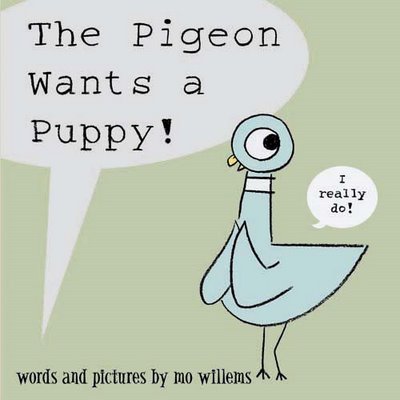
Willems, Mo. The Pigeon Wants a Puppy! 2008 Hyperion Books for Children. ISBN: 978-1-4231-0960-0
Summary
The cute and easily excitable Pigeon wants a puppy and then discovers that getting what he wishes for is more than he "bargained for."
What I thought
One of the best things about this story is how the Pigeon addresses the reader. The book is very theatrical which makes sense because Willems is an Emmy award winning writer for children's television. I've read this story to my own children and at library Story Time and each time I've had a great response. Kids love the Pigeon's expressions and they can identify with how much he wants things that he can't have. The illustrations make this book special and very funny.
Outside Reviews
"The incorrigible bird returns in his fourth full-length romp. This time, Pigeon voices another common childhood dream: he wants a puppy. And he wants it NOW. He even promises to take care of it: "I'll water it once a month." He argues his case so forcefully that a puppy appears, but it's more than he expects: "The teeth! The hair! That wet nose!…I mentioned the teeth, right?" So he sets his sights on a different pet. Kids will love this perfectly paced picture book, which offers both the expected (breaking the fourth wall, Pigeon's classic temper tantrum) and a new twist (Pigeon actually gets what he wants? Impossible!). Willems's hilariously expressive illustrations and engaging text are cinematic in their interplay. Maybe kids won't appreciate the genius behind it the way adults will, but that won't stop them from asking for this book again and again."
MacMillan, K. (2008). The Pigeon Wants a Puppy!. School Library Journal, 54(6), 116. Retrieved from MasterFILE Premier database.
"The charming, exasperating pigeon returns, and this time he REALLY knows what he wants--or at least he thinks he does. As in his previous outings, he addresses the reader--"I'm fine. Thanks for asking"--and communicates a wide range of emotions through minimal words and a few deft pen strokes that brilliantly bring to life his one-of-a-kind personality. Following his now-familiar routine, the pigeon throws a tantrum and slyly attempts to manipulate the reader's (listener's) emotions: "You don't want me to be happy, do you? …You just don't understand." Be careful what you wish for might well be the moral of this tale, since the reality of a puppy turns out to be hilariously larger and more frightening than the pigeon's or readers' expectations. Even though the pigeon may get more than he bargained for, his many fans with find they get exactly what they've come to expect: lots of giggles. (Picture book. 4-8)"
(2008). THE PIGEON WANTS A PUPPY!. Kirkus Reviews, 76(8), 442. Retrieved from MasterFILE Premier database.
Using this book in the library
I've had great success with any Pigeon story at Story Time. Younger children are perfect for this book. Preschool kids don't get bored with the story and they laugh at Pigeon's funny antics. The story where the Pigeon wants to drive the bus (Don't Let the Pigeon Drive the Bus) is the best to read with kids because they love to tell him NO! over and over again.
For Fun:
Visit Pigeon Presents! website. Play games and color printouts that have characters from Mo Willems' books.
Summary
This book is an epic trip across America that is both funny, touching and surreal. Cameron has been diagnosed with Mad Cow Disease and while he is dying, he may be saving the world or having an amazing hallucination. A large cast of interesting characters flesh out this excellent, fun story. Winner of the 2010 Printz Award.
What I thought
Normally, I don't like stories that may or may not be in the narrator's head. However, this story is such an amazing trip, I didn't mind. In some ways, the story reminds me of a few other novels, such as Joseph Heller's Catch-22 and my favorite Fierce Invalids Home from Hot Climates by Tom Robbins. The surreal nature of the story is both fun and disturbing. I am of the opinion that the entire trip, the saving the world and everything takes place in Cameron's dying mind. However, that doesn't take away from the real-life feelings the book invokes. It is a book about celebrating life, being yourself and following dreams. The characters of Balder the Garden Gnome and Gonzo the little person are wonderful. They feel like real people that I wish I could meet.
Outside Reviews
"When sixteen-year-old Cameron was five, he jumped ship on the “It’s a Small World” ride at Disney World and nearly drowned. “The thing is, before they pulled me out, everything had seemed made of magic . . . But the minute I came to on the hard, glittery, spray-painted, fake snow. . . I realized it was all a big fake. The realest thing I’d ever experienced was that moment under the water when I almost died.” This sets the theme for the even wilder ride that follows, when Cameron’s erratic behavior leads to a diagnosis of Creutzfeldt-Jakob (a.k.a. mad cow) disease. With the student body that used to ignore him throwing a save-Cameron pep rally and decorating the gym with paper cows, Cameron and his friend Gonzo, a hypochondriac dwarf, flee the hospital on a mission (as detailed by a punk-rock angel named Dulcie) to save the world from “dark energy”—or do they? Bray gleefully tosses a hallucinogenic mix of elements into the adventure—snow globes, fire demons, a talking yard gnome, a demon-fighting New Orleans jazz musician, and more—but their origins can all be found in Cameron’s mundane prediagnosis life. So is his trip “just a ride,” as his Mom once told him about “It’s a Small World”? Readers will have a great time trying to sort everything out and answer the question at the heart of it all: even if Cameron’s experiences are all a dream, are they any less real?"
C. M., H. (2009). Going Bovine. Horn Book Magazine, 85(5), 553. Retrieved from MasterFILE Premier database.
"In Libba Bray's unconventional novel, winner of the 2010 Michael L. Printz Award, Cameron, the 16-year-old down-and-out protagonist, meanders through varied phantasmagoric experiences after being diagnosed with Creutzfeldt-Jacob ("mad cow") disease. Cam has given up trying to succeed at home, in school, or as one of the cool kids. Instead, he sinks further into disassociation from his world until he is visited by Dulcie (reminiscent of Quixote's Dulcinea), a possibly hallucinatory punk/angel, who convinces Cam there could be a cure, if he is willing to assume great risks in searching for it. And so begins Cam's bizarre quest to thwart evil, unravel the mystery of the disappearing Dr. X--who may hold the key to a cure, but might also be plotting to destroy the world--and beat his terminal diagnosis. Cam is accompanied on this dark roadtrip of an increasingly spongy mind by Dulcie, a hypochondriacal dwarf named Gonzo, and a resilient yard gnome who could possibly be the ancient Viking god, Balder. [Bray] ably narrates this psychedelic ride, with a deft touch of teenage angst and ennui. There is so much going on that listeners could easily lose the twisting thread in an instant of inattention. Filled with slang, four letter words, humor, pathos, satire, absurdities, sex, drugs, rock 'n roll, and the fight between good and evil, this is not a journey for the faint of heart."
Spencer, R. (2010). Going Bovine. School Library Journal, 56(4), 57. Retrieved from MasterFILE Premier database.
Using this book in the library
This book is very unusual and is most likely for older teens. It would be an excellent project to work through some of the mythology and physical science that is mentioned in the book. The science takes on mythic proportions in the terms of alternate universes and the Norse mythology may not be familiar to all readers. Mad Cow Disease is interesting as well, since it is not caused by a virus or any other organism. Instead, bad proteins, called prions, are to blame. These topics may be fun to explore in a book club that has members who enjoy learning new things.
For fun
A few subplots in this story involved garden gnomes. Cameron's father shows his son pictures of "liberated" gnomes taken on trips and photographed in front of landmarks. His father thinks this is clever and funny. One of the characters, Balder, is an enchanted yard gnome. There is a site called "Free the Gnomes." Libby is making a commentary on this practice. In France, 79 yard gnomes were discovered alongside a river bank. People are stealing property and using it to create dubious art.
Module 3 - The Man Who Walked Between the Towers by Mordicai Gerstein
Bibliography
Gerstein, Mordicai. The Man Who Walked Between the Towers. Roaring Book Press, 2003. ISBN: 0-7613-1791-0
Summary
A beautiful story told in words and pictures about Philippe Petite, a real-life acrobat and artist who walked between the Twin Towers for a full hour back and forth with no net and a mile drop underneath him. The book shows how he set up the rope (illegally!) and what happens after his historic walk.
What I thought
This is one of the best post 9/11 books about the Twin Towers that I have ever seen or read. Instead of mourning the towers, this book memorializes them and remembers a beautiful, fun moment from their past. It celebrates life and the joy of accomplishment. It celebrates daring and art. The book is a fun read.
The art is a perfect match for the lyrical, beautiful text. The drawings of Philippe as he performs are joyful, and for someone who hates heights, harrowing! The sense of perspective and potential drop is captured so well, I worried about Philippe every page he was on the wire. There is even a scene where he lays down on the wire: amazing!
This book has the potential to really spark emotions. My partner, who helped clean up at ground zero as a medic, had a hard time listening to me read the story. My kids, however, enjoyed the story very much and were fascinated by the pictures. We ended up reading this book multiple times.
Outside Reviews
"Here’s a joyful true story of the World Trade Center from a time of innocence before 9/11. In 1974 French trapeze artist Philippe Petit walked a tightrope suspended between the towers before they were completed. Gerstein’s simple words and dramatic ink-and-oil paintings capture the exhilarating feats, the mischief, and the daring of the astonishing young acrobat. He knew his plan was illegal, so he dressed as a construction worker, and, with the help of friends,lugged a reel of cable up the steps during the night and linked the buildings in thesky. As dawn broke, he stepped out on the wire and performed tricks above the city. Gerstein uses varied perspectives to tell the story—from the close-up jacket picture of one foot on the rope to the fold-out of Petit high above the traffic, swaying in the wind. Then there’s a quiet view of the city skyline now, empty of the towers, and an astonishing image of the tiny figure high on the wire between the ghostly buildings we remember."
Rochman, H. (2003). The Man Who Walked between the Towers (Book). Booklist, 100(5), 498. Retrieved from Library, Information Science & Technology Abstracts with Full Text database.
"As this story opens, French funambulist Philippe Petit is dancing across a tightrope tied between two trees to the delight of the passersby in Lower Manhattan. Gerstein places him in the middle of a balancing act, framed by the two unfinished World Trade Center towers when the idea hits: "He looked not at the towers, but at the space between them and thought, what a wonderful place to stretch a rope...." On August 7, 1974, Petit and three friends, posing as construction workers, began their evening ascent from the elevators to the remaining stairs with a 440-pound cable and equipment, prepared to carry out their clever but dangerous scheme to secure the wire. The pacing of the narrative is as masterful as the placement and quality of the oil-and-ink paintings. The interplay of a single sentence or view with a sequence of thoughts or panels builds to a riveting climax. A small, framed close-up of Petit's foot on the wire yields to two three-page foldouts of the walk. One captures his progress from above, the other from the perspective of a pedestrian. The vertiginous views paint the New York skyline in twinkling starlight and at breathtaking sunrise. Gerstein captures his subject's incredible determination, profound skill, and sheer joy. The final scene depicts transparent, cloud-filled skyscrapers, a man in their midst. With its graceful majesty and mythic overtones, this unique and uplifting book is at once a portrait of a larger-than-life individual and a memorial to the towers and the lives associated with them."
Lukehart, W., Jones, T., Toth, L., Charnizon, M., Grabarek, D., & Larkins, J. (2003). The Man Who Walked between the Towers (Book). School Library Journal, 49(11), 125. Retrieved from Library, Information Science & Technology Abstracts with Full Text database.
Using this book in the library
At the library I work at this book is considered a biography of Philippe Petite. This could be a good starting point for using the book, especially since many people have the idea that a biography is a boring book about someone's life! This book takes one important incident in Philippe's life and highlights it for the reader. If a person wants to know more about Philippe, they have to find out for themselves. Because this story is so interesting, children won't mind trying to find out more about him or to maybe try more biographies. My kids were very excited to find out that Philippe was a real person who had really performed this beautiful act! I suspect other kids would get a kick out of finding that out and learning more.
For Fun:
Watch news footage from the day Philippe performed his daring act! Best part of the video is watching Philippe in the police station balancing the officer's hats on his nose! There are more videos about him on YouTube, including an interview of him by Steven Colbert.
Module 3 - Bud, Not Buddy by Christopher Paul Curtis
Bibliography
Curtis, Christopher Paul. Bud, Not Buddy. Delacorte Press, 1999. ISBN: 0-385-32306-9
Summary
This excellent book is a two-time award winner. It received the 2000 Newbery Medal and the 2000 Coretta Scott King Award. This story is about a young boy who is all alone in the world. His mother has died, and he has been living in the Home (an orphanage) since he was 6 years old. Bud thinks he knows who his father is and tries to find him in Grand Rapids, Michigan. Along the way, he meets different people, has adventures and lets his rules for living guide him. Everywhere he goes, he takes his suitcase which contains not only secrets of the past, but also hold clues for his future. Set in the Depression era, the story is upbeat rather than sad. Bud's cheerful attitude and his determination keep him going through all of his adventures.
What I think
I enjoyed this book immensely! I don't normally enjoy books with a historical setting, but the adventures that Bud goes through are paramount to the historical nature of the story. I loved Bud's sense of humor with his hilarious "Bud Caldwell's Rules and Things for Having a Funner Life and Making a Better Liar Out of Yourself" that are found appropriately throughout the text. Just as funny are his inadvertent episodes with "vampires" and "ghosts" through the story. Another funny episode involves a librarian trying to give Bud something "special" and Bud says, "I didn't get too excited 'cause I know the kind of things librarians think are special" (p. 89). These scenes make the heartbreaking nature of what Bud has to go through as an African American orphan boy living through the Depression a lighter story than might have otherwise been told.
Overall, I think the use of humor in this story is very important. It's a story that a librarian can easily sell to kids to read based on the fact that its funny and it's a story of a runaway boy's exciting adventures. Kids won't even realize they are learning something. The pictures in the after word really might spark their imaginations, too, because some of the characters were based on the author's family. I would never try to "sell" this book as "Historical Fiction." It's more than a story about a time in history. It's very much a story about a boy finding himself, his family and the adventures he encounters.
Outside Reviews
"Curtis is so perfect for classroom use that I'm going to devote the whole column to it this month. Add this book to your list of must-reads and your list for multiple copies and read-alouds if you work with kids from fourth grade up. As with the author's The Watsons Go to Birmingham (Bantam, 1997, ISBN 0 440-41412-1), we go from laughter to tears in the blink of an eye.
Quite a character. Once you meet Bud, you'll never forget him. His self-constructed set of rules for how to "Have a Funner Life and Make a Better Liar Out of Yourself" may remind some readers of Mouse's emergency rules in Betsy Byars' The Eighteenth Emergency (Viking, 1996, ISBN 0140-31451-2). Bud belongs with Jerry Spinelli's Maniac Magee (Little Brown, 1990, ISBN 0-316-80906-3) and other authors' characters who enlighten the human experience and make us wish we could step into the action to help them find good homes."
Hurst, C. (2000). Meet Bud, Not Buddy. Teaching Pre K-8, 30(7), 72. Retrieved from MasterFILE Premier database.
"In a story that's as far-fetched as it is irresistible, and as classic as it is immediate, a deserving orphan boy finds a home, It's the Depression, and.Bud (not Buddy) is ten and has been on his own since his mother died when he was six. In and out of the Flint, Michigan, children's home and foster homes ever since, Bud decides to take off and find his father after a particularly terrible, though riotously recounted, evening with his latest foster family. Helped only by a few clues his mother left him, and his own mental list of "Rules and Things for Having a Funner Life and Making a Better Liar Out of Yourself," Bud makes his way to a food pantry, then to the library to do some research (only to find that his beloved librarian, one Charlemae Rollins, has moved to Chicago), and finally to the local Hoover ville where be just misses hopping a freight to Chicago. Undaunted, he decides to walk to Grand Rapids, where he hopes his father, the bandleader Herman E. Calloway, will be. Lefty Lewis, the kindly union man who gives Bud a lift, is not the first benevolent presence to help the boy on his way, nor will he be the last. There's a bit of the Little Rascals in Bud, and a bit more of Shirley Temple as his kind heart and ingenuous ways bring tears to the eyes of the crustiest of old men — not his father, but close enough. But Bud's fresh voice keeps the sentimentality to a reasonable simmer, and the story zips along in step with Bud's own panache."
Sutton, R. (1999). Bud, Not Buddy. Horn Book Magazine, 75(6), 737. Retrieved from MasterFILE Premier database.
Using this book in the library
In the after word, Curtis tells the readers about the parts of the story that were based on real-life events. Characters like Lefty Lewis and Herman E. Calloway were based on his grandfathers. Using this book as a starting point, children in a book club or other such group could explore the past. They could be encouraged to find out what their own families have accomplished or what parts of history they remember. They could also search for other events that are mentioned in the book, such as the union organizations and learn more about these aspects of history.
More information!
In one of the earlier scenes in the book, Bud is waiting in line outside the mission with his "pretend family." As they round the corner, everyone sees a sign and starts laughing. The billboard sign shows a rich white family driving in a car with the words: "THERE'S NO PLACE LIKE AMERICA TODAY!" (p. 49-50). This scene was inspired by an actual photograph by Margaret Bourke-White. Here is a link to the picture and some more information about the scene. http://courses.wcupa.edu/johnson/cpc-mbw.htm