Showing posts with label picture book. Show all posts

Tuesday, December 7, 2010

SLIS 5420 - Module 15 - And Tango Makes Three

Module 15 - And Tango Makes Three

Bibliography
Parnell, Peter and Justin Richardson. And Tango Makes Three. Simon & Schuster Children's Publishing, 2005. ISBN: 0-6898-78451

Summary
Roy and Silo are two male chinstrap penguins that paired up together at the Central Park Zoo. For years, they displayed courting behavior, made a nest together and tried to hatch rocks. One day a zoo keeper gave the pair an abandoned egg that they hatched successfully. Tango was the baby they raised together. This is based on a true story.

What I Thought
I thought this book was adorable! My partner and I raise two awesome children and it's really a breath of fresh air to have books out there about families like ours. The illustrations by Henry Cole are cute and animated. My children enjoyed reading the book with me.

This book is, however, one of the most challenged books on the ALA list because it depicts a homosexual relationship (between penguins). I understand that this is a sensitive issue to some people who feel that homosexuality shouldn't be exposed to their children. However, love, partnership, parenting and relationships are beautiful things no matter who you love. This book is beautifully accepting of Roy and Silo and shows how people (like the zoo keeper in the story) can look past the "gay" and see the love.

Outside Reviews
 "Tango has two daddies in this heartwarming tale, inspired by actual events in New York's Central Park Zoo. Two male penguins, Roy and Silo, "did everything together. They bowed to each other.… They sang to each other. And swam together. Wherever Roy went, Silo went too. … Their keeper… thought to himself, 'They must be in love.'" Cole's (The Sissy Duckling) endearing watercolors follow the twosome as they frolic affectionately in several vignettes and then try tirelessly to start a family--first they build a stone nest and then they comically attempt to hatch a rock. Their expressive eyes capture a range of moods within uncluttered, pastel-hued scenes dominated by pale blue. When the keeper discovers an egg that needs tending, he gives it to Roy and Silo, who hatch and raise the female. The keeper says, "We'll call her Tango,… because it takes two to make a Tango." Older readers will most appreciate the humor inherent in her name plus the larger theme of tolerance at work in this touching tale. Richardson and Parnell, making their children's book debut, ease into the theme from the start, mentioning that "families of all kinds" visit the zoo. This tender story can also serve as a gentle jumping-off point for discussions about same-sex partnerships in human society."

(2005). And Tango Makes Three. Publishers Weekly, 252(20), 61. Retrieved from MasterFILE Premier database.

"In this true, straightforwardly (so to speak) delivered tale, two male chinstrap penguins at New York City's Central Park Zoo bond, build a nest and--thanks to a helping hand from an observant zookeeper--hatch and raise a penguin chick. Seeing that the penguins dubbed Roy and Silo "did everything together. They bowed to each other. And walked together. They sang to each other. And swam together," their keeper, Mr. Gramzay, thinks, "They must be in love." And so, when Roy and Silo copy the other penguin couples and build a nest of stones, it's Gramzay who brings a neighboring couple's second egg for them to tend, then names the resulting hatchling "Tango." Cole gives the proud parents and their surrogate offspring small smiles, but otherwise depicts figures and setting with tidy, appealing accuracy. Unlike Harvey Fierstein's groundbreaking The Sissy Duckling (2002), also illustrated by Cole, this doesn't carry its agenda on its shoulder; readers may find its theme of acceptance even more convincing for being delivered in such a matter of fact, non-preachy way."

(2005). AND TANGO MAKES THREE. Kirkus Reviews, 73(11), 642. Retrieved from MasterFILE Premier database.

Using This book in the library
This book has been part of many displays in my library. People are surprised, sometimes, that it's been banned. It's a great topic for starting a good discussion about censorship and what may or may not be appropriate. The biggest challenge to the book is that it depicts a same-sex relationship and some parents aren't ready to tell their children about this part of life. It's important (especially in a public library) to remind parents to always review the choices their children pick. There are picture books about war, death, disease and a variety of issues you may not be ready to share with your children. Age appropriate books do not mean they don't deal with "heavy" issues. They just deal with heavy issues in an age-appropriate way.


For fun and information:
Find out more about the two penguins, Roy and Silo and the scientific thought behind their behavior from Scientific American.

Sunday, November 14, 2010

SLIS 5420 - Module 11 - The Day-Glo Brothers

Module 11 - The Day-Glo Brothers by Chris Barton

Bibliography
Barton, Chris. The Day-Glo Brothers: The True Story of Bob and Joe Switzer's Bright Ideas and Brand New Colors. Charlesbridge, 2009. ISBN: 978-1-57091-673-1

Summary
Bob and Joe Switzer didn't set out to invent Day-Glo paint, but that's what they did and their invention changed the world in small but significant ways.

What I Thought
Since this book is cataloged in my library as Dewey Decimal number 535, I thought I would be learning only about science when I picked up the book. However, while I did learn a little about florescence and chemicals and how the scientific method worked, I also learned about a great life story of two inventors. While Bob and Joe had originally wanted to different things with their lives, fate steered them in a different direction. They weren't able to do the original jobs they wanted, but both were able to help people and create different and new things.

This book is great for exploring the Switzer's lives. The author, Chris Barton, is a historian and his telling their story helps uncover a small but important part of history. The Day-Glo paint and pigment was used to save lives and changed the way we looked at the world.

The illustrations by Tony Persiani are an excellent accompaniment to this story. As the book starts out, most of the illustrations are gray. But as the Switzers discover and invent Day-Glo paint, the pictures in the story become brighter and more colorful.


Outside Reviews

"In this debut for both collaborators, Barton takes on the dual persona of popular historian and cool science teacher as he chronicles the Switzer brothers' invention of the first fluorescent paint visible in daylight. The aptly named Day-Glo, he explains, started out as a technological novelty act (Joe, an amateur magician, was looking for ways to make his illusions more exciting), but soon became much more: during WWII, one of its many uses was guiding Allied planes to safe landings on aircraft carriers. The story is one of quintessentially American ingenuity, with its beguiling combination of imaginative heroes ("Bob focused on specific goals, while Joe let his freewheeling mind roam every which way when he tried to solve a problem"), formidable obstacles (including, in Bob's case, a traumatic accident), a dash of serendipity and entrepreneurial zeal. Persiani's exuberantly retro 1960s drawings--splashed with Day-Glo, of course--bring to mind the goofy enthusiasm of vintage educational animation and should have readers eagerly following along as the Switzers turn fluorescence into fame and fortune."
(2009). The Day-Glo Brothers: The True Story of Bob and Joe Switzer's Bright Ideas and Brand-New Colors. Publishers Weekly, 256(26), 127. Retrieved from MasterFILE Premier database.

"First featured in the Fall Preview, Chris Barton breaks down the story behind the discovery of Day-Glo colors in this tale of two brothers--one practical, one creative--who worked together to develop the neon brights that forever changed the world. The book required extensive research, as Barton delved into one brother's notes and interviews with the family to re-create the story The effort was well worth it. "The final pages explode in Day-Glo radiance," said the Kirkus reviews: "Rendered in 1950s-cartoon style, with bold lines and stretched perspectives, these two putty-limbed brothers shine even more brightly than the paints and dyes they created."

(2009). The Day-Glo Brothers: The True Story of Bob and Joe Switzer's Bright Ideas and Brand-New Colors. Kirkus Reviews, 77(22), 10. Retrieved from Academic Search Complete database.

Using this book in the library
This book would be a good fit for a classroom environment when it's time to introduce both science concepts and history. This books is fun to read and look at and gently introduces both science and biography in a fun way.

Just for fun
Visit the DayGlo company website. This is the company founded by Bob and Joe Switzer. You can request color samples and find out more information about DayGlo today. Now DayGlo colors are in eye makeup, food coloring and other assorted things. The company is located in my hometown of Cleveland, Ohio.

Sunday, October 31, 2010

SLIS 5420 - Module 10 - Pink and Say

Module 10 - Pink and Say by Patricia Polacco

Bibliography

Polacco, Patricia. Pink and Say. Philomel Books, 1994. ISBN: 0-399-22671-0

Summary
When young Sheldon (Say) is wounded in the Civil War, it is Pinkus Aylee who rescues him and carries him to his mother's house. While they are there, they become friends only to be torn away from one another by Confederate Soldiers who place them both in a prison camp. Say lives on to remember Pink who saved his life.

What I Thought
I was almost afraid to pick up this book. Everyone I know who has read it said it made them cry. Then I peeked at the ending and saw that Pink died and I didn't want to see a sad ending. But finally, I read it and I cried. But what made the difference was that I understood the story and felt it deep in my heart. This book really touched me. It's powerful.

There are 3 especially beautiful moments. One beautiful moment is when Moe Moe hold Say who can't sleep because he is afraid of death and afraid of his own perceived lack of courage. The other is when Pink wants to touch the hand of Say who once shook Abe Lincoln's hand. The last moment that is truly beautiful is when Patricia, the writer, points out that when her father told her the story of her ancestor, Say, he put out his hand and said, "This is the hand, that has touched the hand, that has touched the hand, that shook the hand of Abraham Lincoln," (p. 34). This creates a chain of human lives that can trace history back to a connection. Patricia becomes part of the story of history. Her family tells this story to remember Pink, who had no family.

Beautiful!


Outside Reviews
"This book, the story of Polacco's great-great-grandfather, has been passed down from generation to generation in the author-artist's family. Fifteen-year-old soldier Sheldon Russell Curtis - Say to his family - has been left for dead on a Civil War battlefield somewhere in Georgia. A fellow Union soldier, Pinkus Aylee, who is African American - "I had never seen a man like him so close before. His skin was the color of polished mahogany" - discovers him and, with much effort, drags the feverish Say home, where his mother, a slave named Moe Moe Bay, nurses Say back to health. As the boys regain their strength, they become as close as real family and discuss things close to their hearts. Pink shares his special talent: Master Aylee, his owner, had taught him how to read. "'To be born a slave is a heap o' trouble, Say. But after Aylee taught me to read, even though he owned my person, I knew that nobody, ever, could really own me.'" Say receives special comfort from Moe Moe when he admits that he deserted his troop and is afraid to return to the war. On the morning the two boys plan to leave and search for their respective troops, marauding Confederate soldiers arrive and kill Moe Moe. Pink and Say are later captured and become prisoners of the Confederate Army, in Andersonville. Although Say lived to tell this story of friendship and brotherhood, Pink was hanged within hours of arriving at the dreaded prison. Told in Say's colorful, country-fresh voice, the text incorporates authentic-sounding dialect and expressions - such as darky - that would have been used at the time. Polacco's characteristic acrylic, ink, and pencil illustrations are suitably dramatic and focus on the intense physical and emotional joy and pain of the story's three main characters. The remarkable story, made even more extraordinary in its basis in actual events, raises questions about courage, war, family, and slavery. A not-to-be-missed tour de force."

Fader, E., & Silvey, A. (1994). Pink and Say. Horn Book Magazine, 70(6), 724. Retrieved from MasterFILE Premier database.


"Pink and Say by Patricia Polacco is a rarity -- a picture book that can invoke tears. The true story, passed on by Polacco's great-grandfather, tells of 15-year-old Civil War soldier Sheldon "Say" Curtis, who was shot and left to die. Pinkus Aylee, a young black soldier known as Pink, saves Say, who is white, but both are endangered by marauding Southerners. Pink and Say is strong stuff for 6-year-olds; two sympathetic characters die. For older kids, it is a powerful introduction to the horrors of war, without melodrama."

Silver, M. (1994). An off year for kid lit. U.S. News & World Report, 117(22), 95. Retrieved from Academic Search Complete database.


Using this book in the library
This book is a great addition to any unit or book group that is reading about war, history or Black History.


For more information
Visit Patricia Polacco's website about Pink and Say. There are printables and ecards available.

Sunday, September 26, 2010

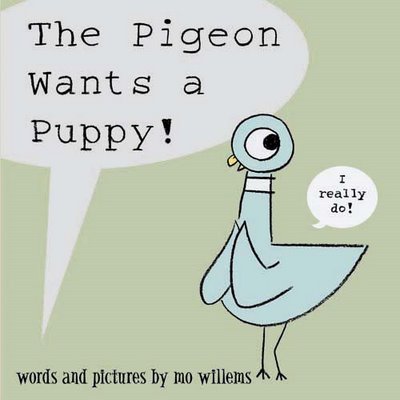
SLIS 5420 - Module 5 - The Pigeon Wants a Puppy

Module 5 - The Pigeon Wants a Puppy - Mo Willems

Bibliography
Willems, Mo. The Pigeon Wants a Puppy! 2008 Hyperion Books for Children. ISBN: 978-1-4231-0960-0

Summary
The cute and easily excitable Pigeon wants a puppy and then discovers that getting what he wishes for is more than he "bargained for."

What I thought
One of the best things about this story is how the Pigeon  addresses the reader. The book is very theatrical which makes sense because Willems is an Emmy award winning writer for children's television. I've read this story to my own children and at library Story Time and each time I've had a great response. Kids love the Pigeon's expressions and they can identify with how much he wants things that he can't have. The illustrations make this book special and very funny.


Outside Reviews
 "The incorrigible bird returns in his fourth full-length romp. This time, Pigeon voices another common childhood dream: he wants a puppy. And he wants it NOW. He even promises to take care of it: "I'll water it once a month." He argues his case so forcefully that a puppy appears, but it's more than he expects: "The teeth! The hair! That wet nose!…I mentioned the teeth, right?" So he sets his sights on a different pet. Kids will love this perfectly paced picture book, which offers both the expected (breaking the fourth wall, Pigeon's classic temper tantrum) and a new twist (Pigeon actually gets what he wants? Impossible!). Willems's hilariously expressive illustrations and engaging text are cinematic in their interplay. Maybe kids won't appreciate the genius behind it the way adults will, but that won't stop them from asking for this book again and again."

MacMillan, K. (2008). The Pigeon Wants a Puppy!. School Library Journal, 54(6), 116. Retrieved from MasterFILE Premier database.

"The charming, exasperating pigeon returns, and this time he REALLY knows what he wants--or at least he thinks he does. As in his previous outings, he addresses the reader--"I'm fine. Thanks for asking"--and communicates a wide range of emotions through minimal words and a few deft pen strokes that brilliantly bring to life his one-of-a-kind personality. Following his now-familiar routine, the pigeon throws a tantrum and slyly attempts to manipulate the reader's (listener's) emotions: "You don't want me to be happy, do you? …You just don't understand." Be careful what you wish for might well be the moral of this tale, since the reality of a puppy turns out to be hilariously larger and more frightening than the pigeon's or readers' expectations. Even though the pigeon may get more than he bargained for, his many fans with find they get exactly what they've come to expect: lots of giggles. (Picture book. 4-8)"

(2008). THE PIGEON WANTS A PUPPY!. Kirkus Reviews, 76(8), 442. Retrieved from MasterFILE Premier database.

Using this book in the library
I've had great success with any Pigeon story at Story Time. Younger children are perfect for this book. Preschool kids don't get bored with the story and they laugh at Pigeon's funny antics. The story where the Pigeon wants to drive the bus (Don't Let the Pigeon Drive the Bus)  is the best to read with kids because they love to tell him NO! over and over again.

For Fun:
Visit Pigeon Presents! website. Play games and color printouts that have characters from Mo Willems' books.

Sunday, September 12, 2010

SLIS 5420 - Module 3 - The Man Who Walked Between the Towers

Module 3 - The Man Who Walked Between the Towers by Mordicai Gerstein

Bibliography
Gerstein, Mordicai. The Man Who Walked Between the Towers. Roaring Book Press, 2003. ISBN: 0-7613-1791-0


Summary
A beautiful story told in words and pictures about Philippe Petite, a real-life acrobat and artist who walked between the Twin Towers for a full hour back and forth with no net and a mile drop underneath him. The book shows how he set up the rope (illegally!) and what happens after his historic walk.

What I thought
This is one of the best post 9/11 books about the Twin Towers that I have ever seen or read. Instead of mourning the towers, this book memorializes them and remembers a beautiful, fun moment from their past. It celebrates life and the joy of accomplishment. It celebrates daring and art. The book is a fun read.

The art is a perfect match for the lyrical, beautiful text. The drawings of Philippe as he performs are joyful, and for someone who hates heights, harrowing! The sense of perspective and potential drop is captured so well, I worried about Philippe every page he was on the wire. There is even a scene where he lays down on the wire: amazing!

This book has the potential to really spark emotions. My partner, who helped clean up at ground zero as a medic, had a hard time listening to me read the story. My kids, however, enjoyed the story very much and were fascinated by the pictures. We ended up reading this book multiple times.

Outside Reviews
"Here’s a joyful true story of the World Trade Center from a time of innocence before 9/11. In 1974 French trapeze artist Philippe Petit walked a tightrope suspended between the towers before they were completed. Gerstein’s simple words and dramatic ink-and-oil paintings capture the exhilarating feats, the mischief, and the daring of the astonishing young acrobat. He knew his plan was illegal, so he dressed as a construction worker, and, with the help of friends,lugged a reel of cable up the steps during the night and linked the buildings in thesky. As dawn broke, he stepped out on the wire and performed tricks above the  city. Gerstein uses varied perspectives to tell the story—from the close-up jacket picture of one foot on the rope to the fold-out of Petit high above the traffic, swaying in the wind. Then there’s a quiet view of the city skyline now, empty of  the towers, and an astonishing image of the tiny figure high on the wire between the ghostly buildings we remember."
Rochman, H. (2003). The Man Who Walked between the Towers (Book). Booklist, 100(5), 498. Retrieved from Library, Information Science & Technology Abstracts with Full Text database.
"As this story opens, French funambulist Philippe Petit is dancing across a tightrope tied between two trees to the delight of the passersby in Lower Manhattan. Gerstein places him in the middle of a balancing act, framed by the two unfinished World Trade Center towers when the idea hits: "He looked not at the towers, but at the space between them and thought, what a wonderful place to stretch a rope...." On August 7, 1974, Petit and three friends, posing as construction workers, began their evening ascent from the elevators to the remaining stairs with a 440-pound cable and equipment, prepared to carry out their clever but dangerous scheme to secure the wire. The pacing of the narrative is as masterful as the placement and quality of the oil-and-ink paintings. The interplay of a single sentence or view with a sequence of thoughts or panels builds to a riveting climax. A small, framed close-up of Petit's foot on the wire yields to two three-page foldouts of the walk. One captures his progress from above, the other from the perspective of a pedestrian. The vertiginous views paint the New York skyline in twinkling starlight and at breathtaking sunrise. Gerstein captures his subject's incredible determination, profound skill, and sheer joy. The final scene depicts transparent, cloud-filled skyscrapers, a man in their midst. With its graceful majesty and mythic overtones, this unique and uplifting book is at once a portrait of a larger-than-life individual and a memorial to the towers and the lives associated with them."
Lukehart, W., Jones, T., Toth, L., Charnizon, M., Grabarek, D., & Larkins, J. (2003). The Man Who Walked between the Towers (Book). School Library Journal, 49(11), 125. Retrieved from Library, Information Science & Technology Abstracts with Full Text database.


Using this book in the library
At the library I work at this book is considered a biography of Philippe Petite. This could be a good starting point for using the book, especially since many people have the idea that a biography is a boring book about someone's life! This book takes one important incident in Philippe's life and highlights it for the reader. If a person wants to know more about Philippe, they have to find out for themselves. Because this story is so interesting, children won't mind trying to find out more about him or to maybe try more biographies. My kids were very excited to find out that Philippe was a real person who had really performed this beautiful act! I suspect other kids would get a kick out of finding that out and learning more.


For Fun:
Watch news footage from the day Philippe performed his daring act! Best part of the video is watching Philippe in the police station balancing the officer's hats on his nose! There are more videos about him on YouTube, including an interview of him by Steven Colbert.

Sunday, September 5, 2010

SLIS 5420 - Module 2 - Freight Train

Module 2 - Freight Train by Donald Crews


Bibliography
Crews, Donald. Freight Train. Scholastic Inc, 1989. ISBN: 978-0590426947

Summary
Freight Train is a very simple and very satisfying story describing a rainbow-colored train and its journey through the landscape. The art is as important as the text in this book. The book received a 1979 Caldecott Honor Award.

What I think about Freight Train
I wanted to write about Freight Train because it's one of my son's favorite books. The simplicity of the story and the illustrations are a perfect match. The opening merely shows an empty train track against a bare white background. The words are so simple:

"A train runs across this track."
The ending is also simple and satisfying. After the train has sped up and passed through the landscape it is now only showing as a wisp of smoke and is:


"Going, going...gone."
I feel that the book's understated wording and cleanly illustrated pictures are what make it feel so good to read and look at. The book is a breath of fresh air when the world is a cluttered, busy place. There is order and simplicity in Crew's illustrated world and that's something that I find very satisfying.

Outside Reviews
"Crews did a fine job with Freight Train's illustrations which aptly convey the excitement of a train rushing by in a blur of color."

DeVinney, G., & Gerhardt, L. (1978). Freight Train/Rain (Book Review). School Library Journal, 25(2), 131. Retrieved from Library, Information Science & Technology Abstracts with Full Text database.


Using this book in the library
I have read this story not only for my own children, but also for children who come to our library story time. I am amazed at how engaged children are with this book. They enjoy shouting out the colors as I am reading and pointing to the different trains in the beginning. They enjoy it as the train speeds up and starts to travel. The book can be used in a few different kinds of story time activities. It can be used in a theme about vehicles. It can also be used to describe and help children recognize colors. It is a book primarily for smaller children and they do enjoy it very much and I feel all kids should get a chance to have this book read to them.

For fun
Learn more about Donald Crews. Donald Crews is part of a very diverse family. I enjoyed learning about him and his family.

Sunday, August 29, 2010

SLIS 5420 - Module 1 - The Giving Tree


Module 1 The Giving Tree by Shel Silverstein

Bibliography
Silverstein, Shel. The Giving Tree. Harper Collins Publishers, 1964. ISBN 0-06-025665-6

Summary
The Giving Tree
by Shel Silverstein is a picture book that tells the story of a boy and his relationship to a very animated apple tree. The story starts out when the boy is very young and the tree is still very healthy. As the story progresses, the boy grows up and wants and takes more and more from the tree until the tree is used up. All throughout the story, the tree is happy despite the demands of giving placed upon her. The book can be read on many different levels and that is probably why it still remains a favorite among many people.

What I think about The Giving Tree
As a child, I enjoyed the story. I liked (and still like) the animated and loose drawings that Silverstein uses to illustrate the book. The drawings are absolutely perfect and speak volumes. On page 19, there is a great picture of the boy and the tree sharing a hug that is just beautiful. In fact, all of the fun illustrations of the boy in his childhood are playful and really speak of the joy of being young. As the boy grows older, though, his posture and unhappiness really show through in the drawings. We never see a true smile again until he is old and sitting with the now stump of a tree.

I find the story to be very sad overall. The sense of joy the boy feels is lost when he becomes a man. That seems wrong to me. Why would joy in life disappear as he gets older? In some ways, the responsibilities the man feels to make money and build a house are the cause of his distress. When the man needs nothing but love, he is happy. This happens when he is a boy and again when he is very old. One theme this story promotes is that when a person does not need anything, they are happiest. The boy does feel that way again until he is very old. That is why I find the book to be sad, because I feel that life is short and should always be joyful.

The fact that the tree gives and gives into the demands of the boy is also painful to watch. She grows smaller and smaller as she is used up by the boy and still she gives. As a child, I didn't understand why she wanted to be destroyed. As an adult, I understand the need to give, but I don't find it healthy to give until there is nothing left of yourself. This book could be a good starting point for discussing giving with children and whether or not love should be so demanding.

Outside reviews:
"The Giving Tree shares the story of a young boy and his lifetime relationship with a certain apple tree. But it is much more than that. It is also a story of giving (and taking or receiving), friendship, happiness, loyalty, sacrifice, gratitude, happiness, and most importantly—love.

The tree ultimately gives everything for the boy without receiving much in return. The theme or message of the book has been interpreted in many different ways. It can be very simply understood by a second grader, or an adult can search for a deeper meaning."

Brodie, C. (2009). The Giving Tree by Shel Silverstein--A Forty-Five Year Celebration. School Library Monthly, 26(1), 22-24. Retrieved from Library, Information Science & Technology Abstracts with Full Text database.

"The Giving Tree (1964) lauded on its inside cover as a "tender story" about "the gift of giving and a serene acceptance of another's capacity to love in return," generated much vehement anger from [college] students of both sexes for its utter exploitation of the woman (tree) by the man (the boy who allegedly "loves" her)."
Juchartz, L. (2003). Team teaching with Dr. Seuss and Shel Silverstein in the college basic reading classroom. Journal of Adolescent & Adult Literacy, 47(4), 336-341. Retrieved from Education Research Complete database.


Using this book in the library:
This is a great book to use in a book club or book discussion group with kids. It's an ice-breaker because the pictures are engaging and easy to talk about. Once past the pictures, kids can be encouraged to discuss how they interpret the story.

For Fun:
Check out these tattoos inspired by The Giving Tree:
http://bookshelvesofdoom.blogs.com/bookshelves_of_doom/2008/05/run-away-run-aw.html